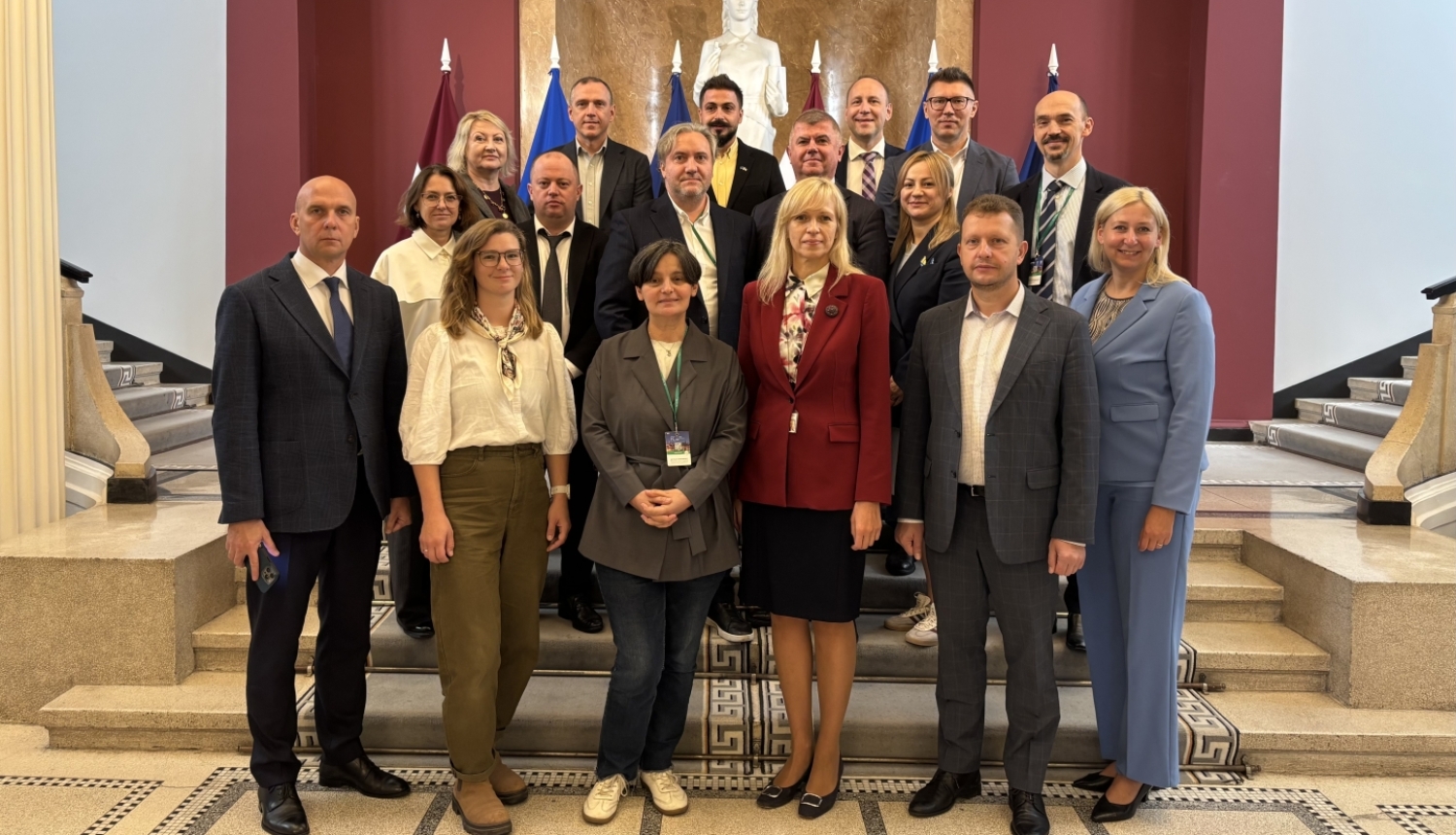
On 11 September, a delegation of Ukrainian state secretaries and representatives of civil society organisations visited the State Chancellery to gain insight into Latvia’s public administration practices. Discussions focused on the role of state secretaries and department heads in the public administration of Latvia, practical examples of modernisation and innovation, as well as approaches to human resource management, motivation and training.
The Ukrainian colleagues were introduced to the main areas and activities of public administration modernisation in Latvia. Representatives of the State Chancellery emphasised the important role of dialogue between the state and service users, as positive personal experience can help increase public trust – one of the indicators that both countries seek to improve. “Citizens expect more forms of direct communication and participation that enable the public administration to listen to what they really need,” said Ilona Anna Eklona, Head of the Public Administration Policy Department. She also highlighted the importance of data in decision-making that is a key focus of the work of the State Chancellery’s Analytical Service, and the introduction of ex-post evaluations, which help assess the actual impact of a legal act 3–5 years after its adoption.
The discussion was held at the State Chancellery’s Innovation Laboratory, where its head, Evija Taurene, introduced her Ukrainian colleagues to the laboratory’s operating principles and the results it has achieved. The laboratory serves as a methodological centre that helps the public sector to understand the needs of society and address specific challenges in policy development, service improvement and the reduction of administrative burdens. A team of innovation and service design experts also trains change leaders to promote a broader shift in service culture and mindset within public administration.
The guests were also presented with Latvia’s approach to developing human resources policy in public administration and examples from practice, with particular emphasis on a people-centred approach, close cooperation with institutions, and the significant role of heads of institutions in driving change and strengthening public administration capacity. “Our approach to developing human resources policy is based on partnership – on open dialogue, shared understanding and solutions that we develop together,” emphasised Ērika Todjēre, Head of the Human Resources Policy Department. The guests were particularly interested in Latvia’s experience in the selection and development of senior managers, as Ukraine, while continuing its public administration reforms, needs to strengthen its professional approach to selecting senior managers. Latvia’s approach to strengthening cooperation with the academic community by forging closer links between public administration, research and knowledge was also welcomed.
The public sector in both Latvia and Ukraine is facing generational change, rapid technological development and the need to acquire new skills and knowledge at a fast pace. Agita Kalviņa, Director of the School of Public Administration, heads a training centre that organises and delivers specialised training and courses tailored to the needs of the public sector. “The transformation of human resources is meaningful only when it is systematic and training is targeted at developing the competences required by the institution and for the specific post,” she emphasized in a discussion with Ukrainian representatives involved in public administration reforms.